Predicted vs solved
The full map, without the solve
A network trained on WarpStack's own 3D output returns the full warpage map without solving. It is global: once trained for a design, it answers anywhere in that design's material and thermal space, in milliseconds. The figures below are measured on the 2nm CoWoS reference design.
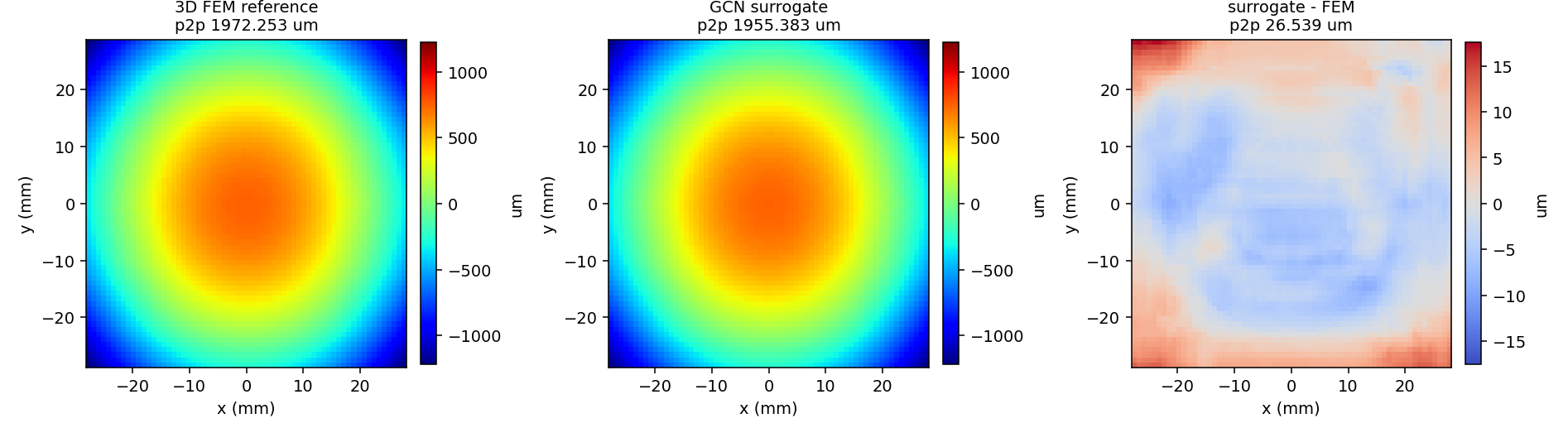
Predicted vs solved, on a design point the network never saw
2nm CoWoS package · 56 × 57 mm · active surface
WarpStack-GNN learns a package’s warpage behaviour from results produced by the detailed 3D method, then returns the full map without solving. Here it is asked for a design point held out of training, and the same point is solved from scratch in 3D for comparison.
AI inference vs numerical solve
Per-design runtime and accuracy · single core
| Method | Runtime | vs 3D | Error vs 3D |
|---|---|---|---|
| Full 3D solve reference | 41.54 s | 1× | — |
| WarpStack-GNN GNN | 19.4 ms | 2,146× | 0.49% |
WarpStack-GNN returns a full warpage map in 19.4 ms — 2,146× faster than solving the same package in 3D. Measured against six independent full 3D solves, the whole-map difference is 0.49% of peak-to-peak and the peak-to-peak bow itself lands within 1.89%.
How closely the GNN tracks 3D
512 held-out design points, materials and thermal load varied
| Quantity | Held-out set | Fresh 3D solves |
|---|---|---|
| Design points | 512 | 6 |
| Mean 3D peak-to-peak | 1,393 µm | 1,699 µm |
| Whole-map difference | 0.38% | 0.49% |
| Peak-to-peak error | 1.41% | 1.89% |
| Correlation with 3D | 0.9996 | 0.99996 |
Every held-out point varies the material set and the thermal load, and the held-out material configurations are kept entirely out of training — so the network is scored on combinations it was never shown.
The design it was measured on
2nm CoWoS HBM4 + GPU stack, imported from IEEE 3Dblox
| Package | 56.2 × 57.5 mm |
| Stacked die columns | 135 |
| Mechanical layers | 237 |
| Solid elements | 45,035 |
| Degrees of freedom | 169,602 |
| Full 3D solve | 41.54 s |
An 8-stack HBM4 + dual-GPU CoWoS package read straight from its IEEE 3Dblox description — every layer, material, and die placement taken from the source design with no hand re-entry. WarpStack-GNN is trained per design, on warpage produced by the detailed 3D method for that same stack.
What it costs to get there
One-time training, then milliseconds per design point
| Training labels (1,792 points) | 32.2 min |
| Network training | 50.8 min |
| Total one-time cost | 83.1 min |
| Per design point afterwards | 19.4 ms |
| Break-even vs solving directly | 120 points |
Training data comes from WarpStack’s own 3D formulation, generated far more efficiently than a brute-force sweep of solves — 1,792 labelled warpage fields in 32 minutes rather than the day a design point at a time would cost. Past 120 design points the network is cheaper than solving directly, and a 1,000-point sweep drops from 11.5 hours to 83 minutes.
What to know before you rely on it. A network is trained per design: changing a thickness or a footprint changes the model and requires retraining, and the checkpoint refuses to load against a design it was not built for rather than returning plausible numbers for the wrong stack. Accuracy is reported against WarpStack's own 3D method at a fixed resolution, not against measurement. Generalization to designs outside the one a network was trained on has not yet been measured. The 2nm CoWoS mechanical properties are illustrative values for the material classes involved, not calibrated process data — so absolute warpage in microns is indicative; the speedup and the method-to-method agreement do not depend on it. For warpage checked across resolutions, see white paper No. 01.