Full-chip multiphysics reliability sign-off

Temperature-aware EM, TM & IR-drop analysis for the full chip

EMSpice 3 is a multiphysics framework for coupled electromigration, thermomigration, and IR-drop analysis of real power-grid networks — driven by realistic spatial thermal maps, Joule heating, iterative resistance feedback, and Monte Carlo lifetime prediction.

1.18–1.50×
Krylov speedup, zero metric error
6
industrial-scale designs validated
10,900
stress nodes per tree resolved

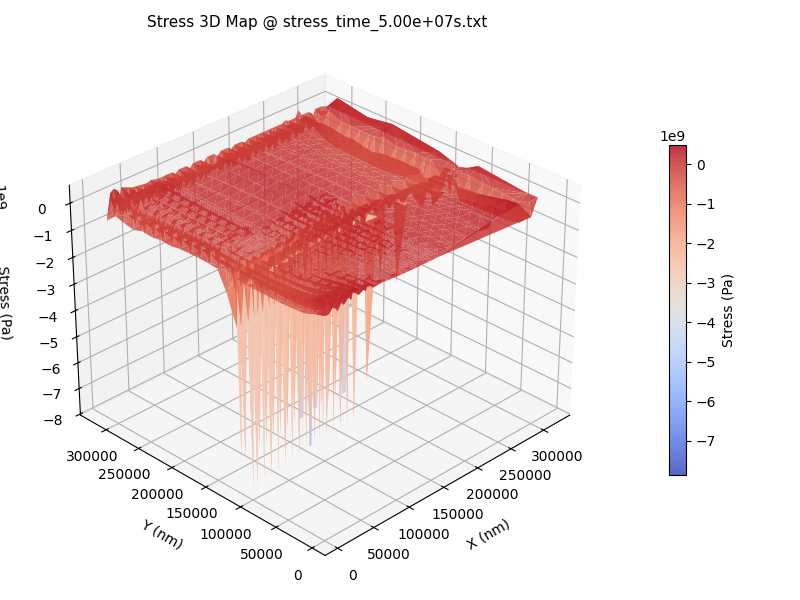
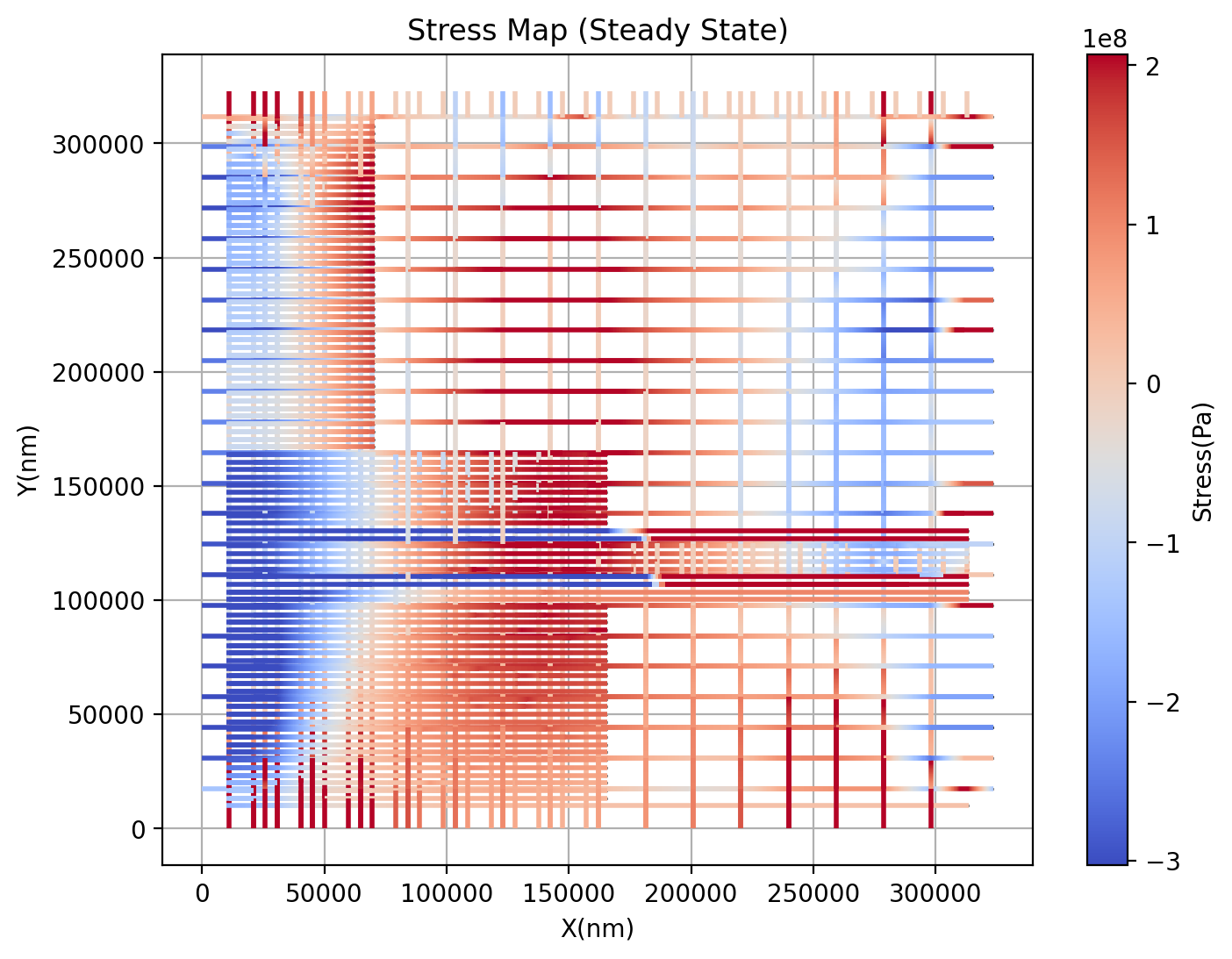
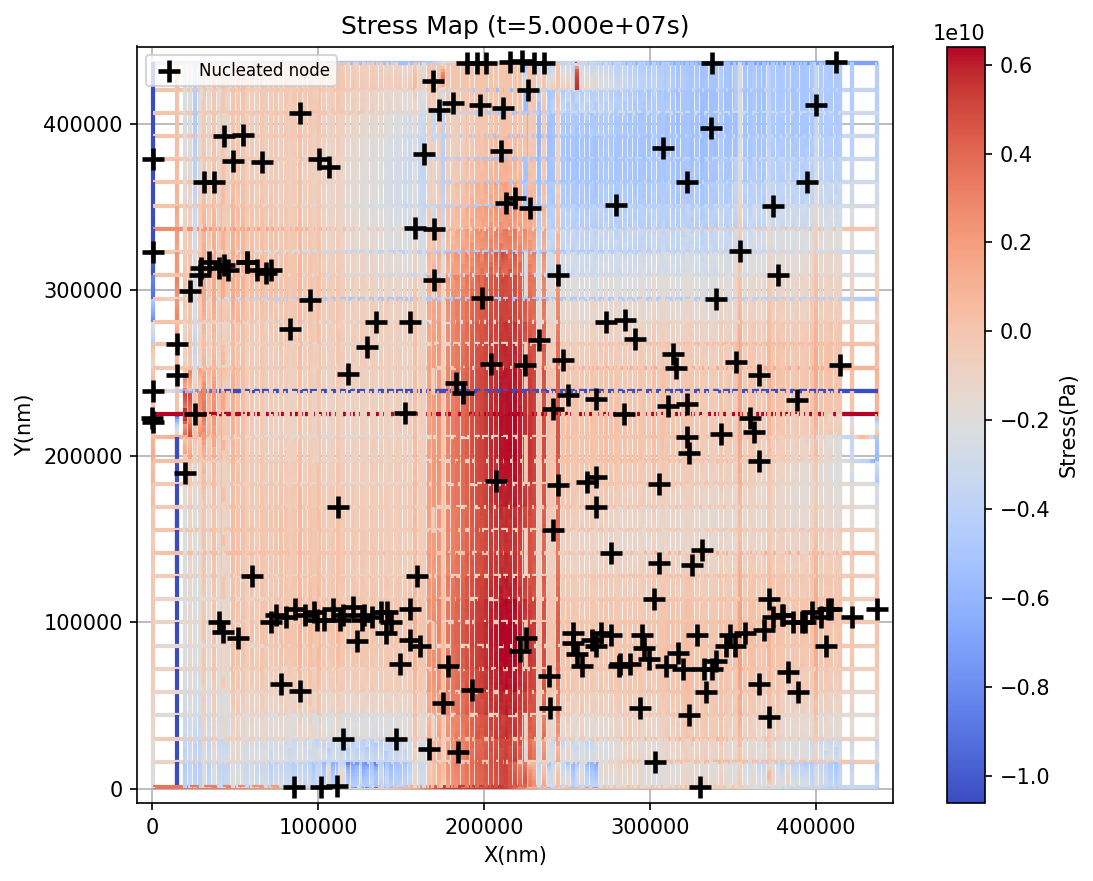
Full-chip stress & void map

Coupled EM/TM stress over an extracted power grid
low stress tensile nucleation hotspot void site
Why EMSpice 3

The first full-chip EM-IR flow that treats thermal structure as a first-order effect

Traditional EM models (Black's equation, Blech's limit) are over-conservative, and even physics-based Korhonen solvers usually assume a uniform die temperature. EMSpice 3 closes that gap — it jointly incorporates Joule heating, practical chip-level thermal maps, coupled EM/TM stress evolution, iterative resistance feedback, and Monte Carlo lifetime prediction in a single sign-off-ready flow.

EM + TM + IR
Coupled multiphysics, not isolated Korhonen solves
0%
Krylov metric error vs. full FDTD reference
100
Monte Carlo samples per design for statistical TTF
EDA
Open-source OpenROAD + Synopsys ICC / Fusion Compiler
Capabilities

What EMSpice 3 can do

A complete design-to-failure pipeline for power-grid reliability, built for realistic full-chip designs.

Coupled EM / TM / IR-drop

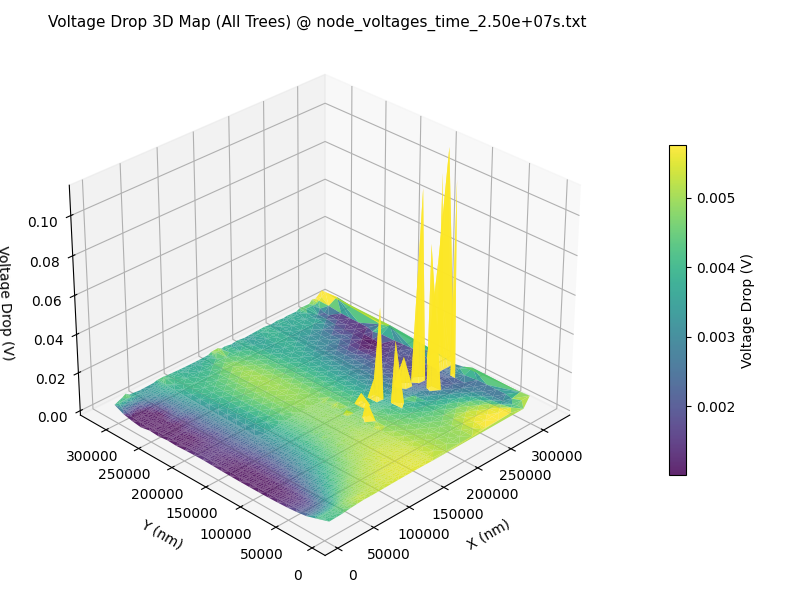
Solves the discretized Korhonen stress equation coupled with an MNA IR-drop solver, capturing electromigration and thermomigration together with the electrical network.

Realistic spatial thermal maps

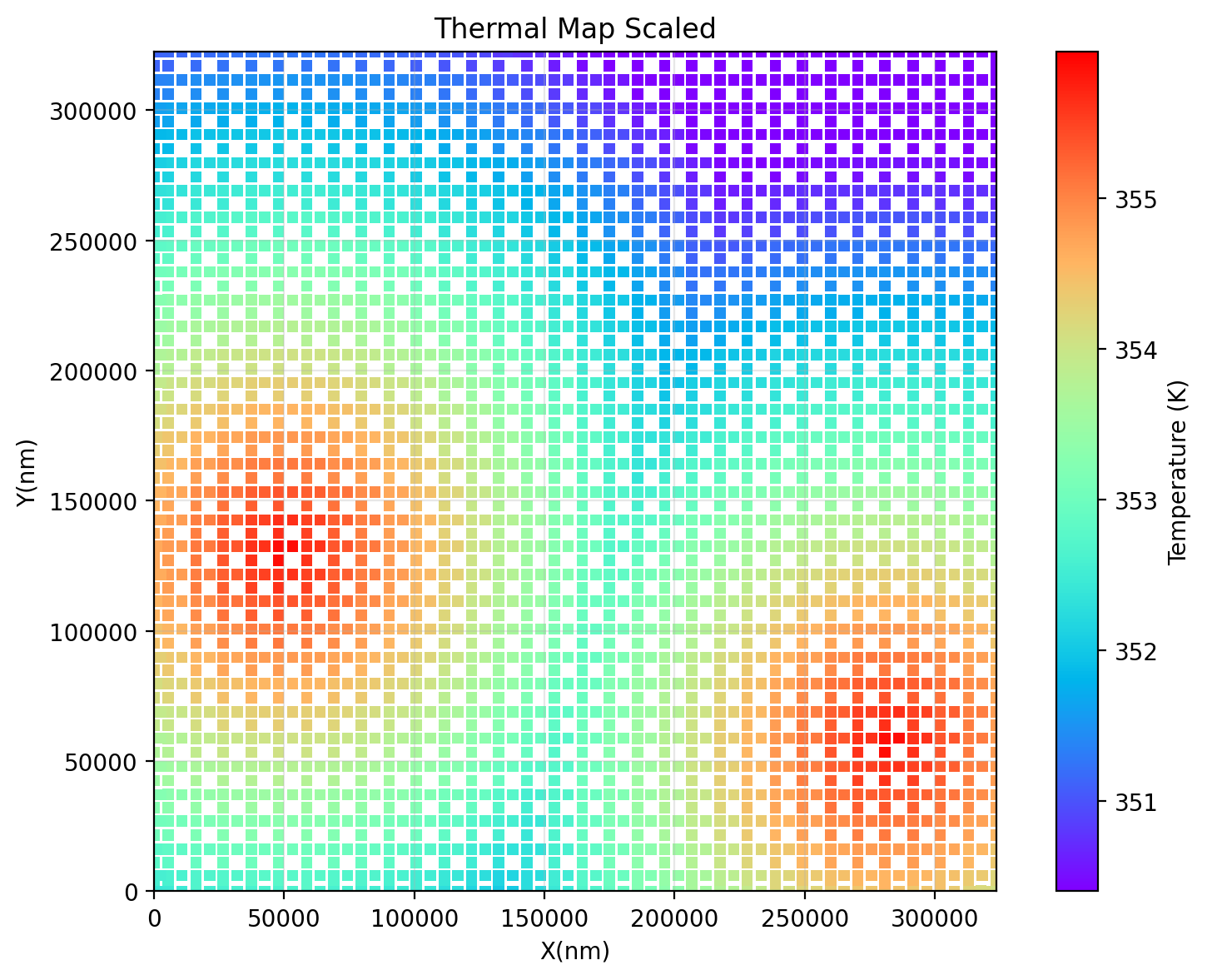
Accepts external chip-level temperature maps (including real measured profiles) instead of assuming a uniform die — spatial hotspot alignment can dominate average temperature in setting reliability.

Joule self-heating

Computes per-node, per-segment wire temperature from current density and path resistance, resolving localized self-heating peaks superimposed on the ambient field.

Iterative resistance feedback

Closes the electrical–thermal–reliability loop: void-driven resistance changes are written back to the netlist so every IR-drop solve reflects the current aging state of the grid.

Monte Carlo lifetime prediction

Re-runs the full pipeline across sampled material parameters to produce TTF distributions, not just a single number — revealing strongly design-dependent variation sensitivity.

Synopsys & OpenROAD integration

Operates on power-grid netlists from both the open-source OpenROAD flow and Synopsys ICC / Fusion Compiler, retaining via resistances for accurate early-failure assessment — validated on six industrial-scale designs.

Agentic-ready

Fully agentic-flow aware

A scriptable command-line interface and structured data interface make EMSpice 3 fully agentic-flow aware — it plugs into any agentic EDA flow to drive automated, closed-loop IR-drop and EM sign-off analysis, with every input and output exposed for programmatic control by AI agents and orchestration scripts.
Inside the framework

How the analysis flows

From extracted netlist to aging trajectory in a single coupled loop — with optional steady-state screening and Krylov acceleration on the heavy trees.

Parse inputs

Power-grid netlist, a YAML of material/solver parameters, and an optional spatial thermal map.

Immortality screening

An optional steady-state pass prunes trees that can never fail, concentrating compute on mortal trees.

IR-drop + thermal solve

MNA returns nodal voltages and branch current densities; the thermal field is loaded and cached per step.

Transient stress (FDTD)

Per tree, the solver evolves hydrostatic stress, tracks void nucleation & growth — big trees via rational Krylov, small trees via backward Euler.

Resistance update & loop

Via-aware early/late failure updates are written back to the netlist, closing the loop into the next aging step.

Acceleration

Rational Krylov subspace

Projects each n-node stress system onto an order-q subspace (q << n). A shifted resolvent regularizes the Neumann singularity for stable convergence, dispatched only when n ≥ max(3q,30).

Novelty

Robin-BC mid-tree nucleation

Enforces the zero-flux void condition at interior junction nodes via a Robin stencil — no dynamic tree splitting or matrix re-meshing at runtime.

Accuracy

Via-aware early failure

Retains via resistances through netlist conversion and checks early-failure (open-circuit) conditions continuously during void growth, not just at nucleation.

Performance

Cache, vectorize, batch-lift

LRU basis caching, loop-free vectorized time stepping on uniform grids, and a single BLAS dgemm batch lift back to full space.

Results

Spatial thermal structure changes the verdict

Across real designs, equal-average thermal profiles produce different mortal-tree counts, void locations, and time-to-failure — proving that average temperature alone is insufficient for sign-off.

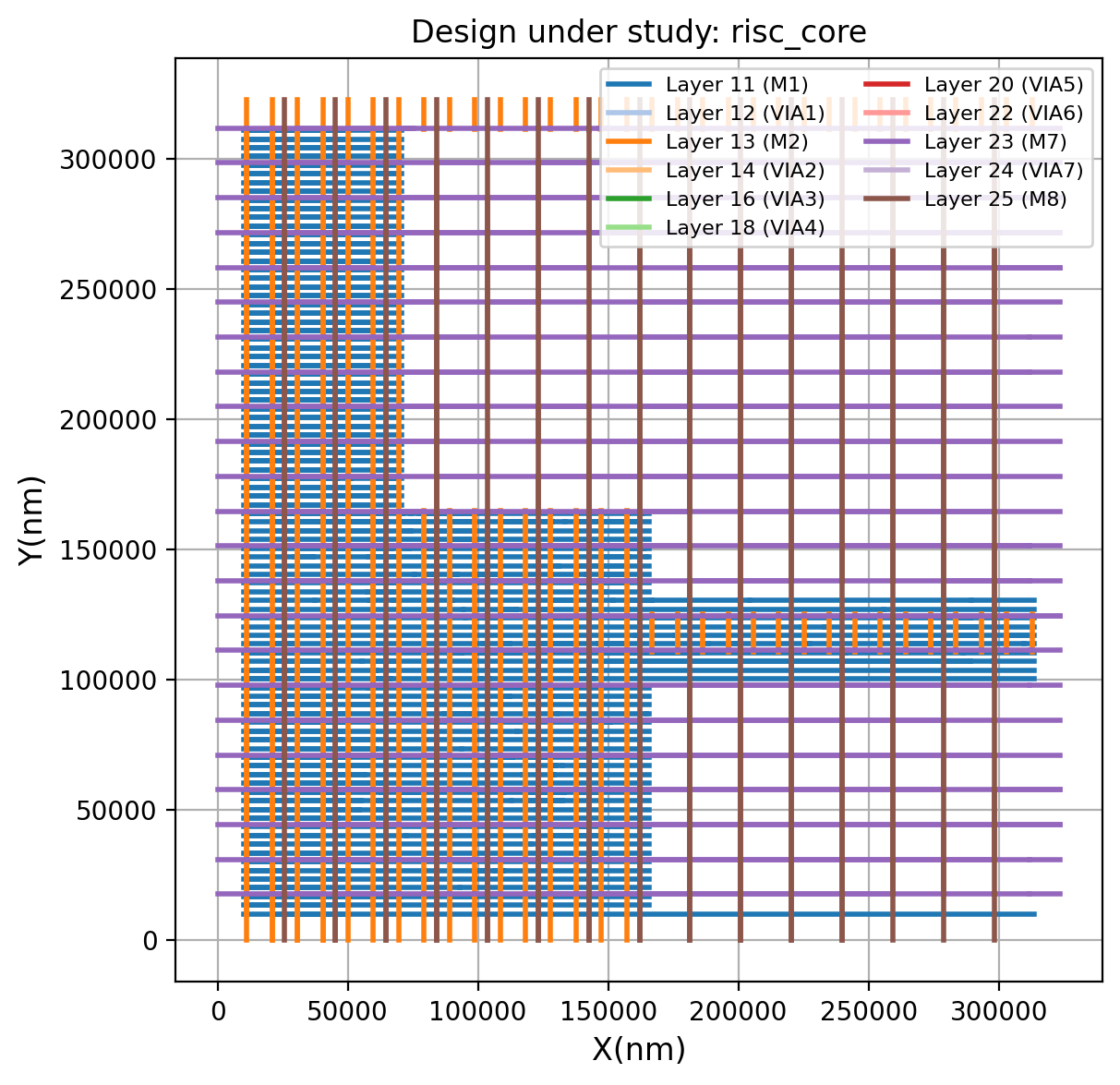
RISC-V core — thermal profile sweep

186 trees · 4 metal layers · 0.95 V · TTF = time to cross the 10% IR-drop threshold
Thermal profileAvg (K)Max (K)MortalTTF (s)
Uniform 353K353.0353.071.32×10⁷
Joule (avg 320K)320.6345.9143.01×10⁷
Joule (avg 353K)353.4387.1182.47×10⁷
Joule (avg 373K)373.6407.3181.45×10⁷
Qualcomm (avg 309K)309.6336.9121.87×10⁷
Qualcomm (avg 353K)353.2387.616no fail
Qualcomm (avg 373K)373.4407.716no fail

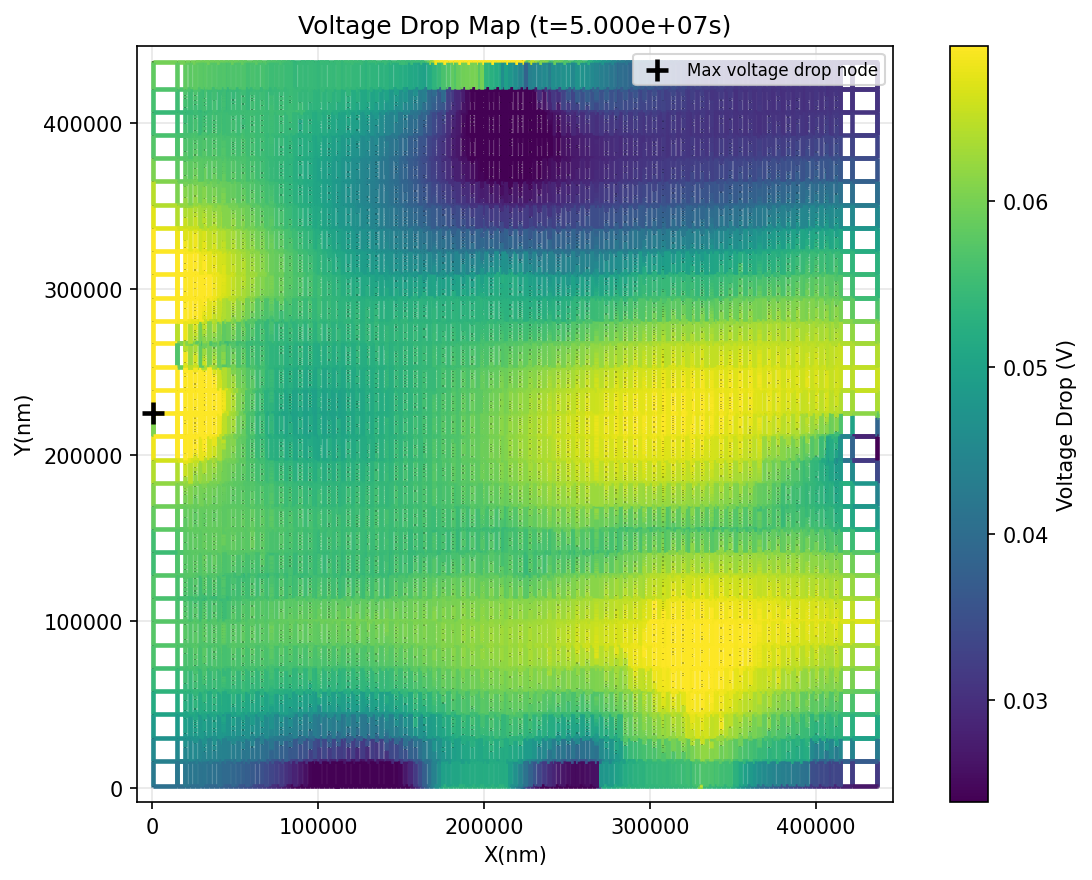
Two 353K maps with nearly identical max temperature (387.1K vs 387.6K) give opposite outcomes — the baseline map fails at ~9.4 months while the broad Qualcomm map never crosses the threshold, because its hotspot doesn't align with the critical current paths.

ARM Cortex-A logic core — thermal sweep

208 trees · up to 10,900 nodes/tree · 1.2 V · deeply mortal current-density regime
Thermal profileAvg (K)Max (K)MortalTTF (s)
Uniform 353K353.0353.02071.05×10⁷
Joule (avg 320K)320.4352.72061.04×10⁷
Joule (avg 353K)353.1385.42061.05×10⁷
Joule (avg 373K)373.3405.62061.05×10⁷
Qualcomm (avg 309K)309.6341.82061.01×10⁷
Qualcomm (avg 353K)353.2385.42061.00×10⁷
Qualcomm (avg 373K)373.4405.62061.00×10⁷

With ~206 deeply mortal trees, M1 current densities push nearly the entire grid far past the nucleation threshold. The TTF stays clamped near 10⁷ s even as max temperature ranges over 60K — a regime where the failure time is deterministic.

Monte Carlo statistical lifetime

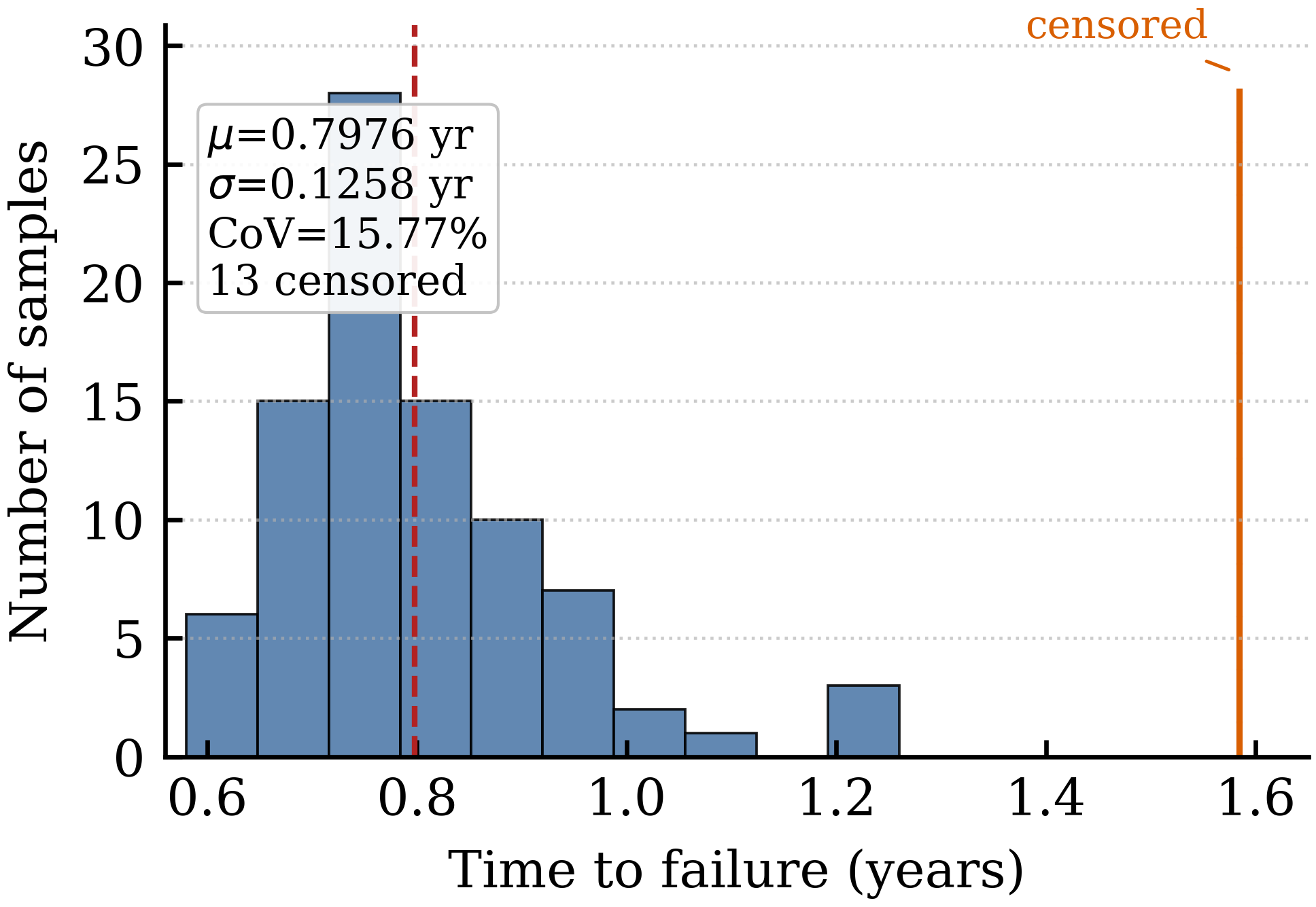
100 samples · 20% CoV on EM diffusivity κ(x) and critical stress · 353K Joule map
15.77%
TTF coefficient of variation — RISC-V core (18 mortal trees)
0.0058%
TTF coefficient of variation — ARM core (206 mortal trees)

Variation sensitivity is design-dependent. Designs with a few marginally mortal trees benefit most from statistical analysis; deeply mortal designs are nearly deterministic. For RISC-V, 87/100 runs failed (TTF 0.60–1.23 yr) and 13 were censored at the simulation horizon.

Rational Krylov speedup

Wall-clock vs. full FDTD reference · zero TTF / final-IR metric error
dual_ram
1.50×
armcore_logic
1.29×
JPEG_new
1.26×
AES_new
1.21×
risc_core
1.21×
armcore_pad
1.18×
Benchmarks

Validated across six industrial-scale designs

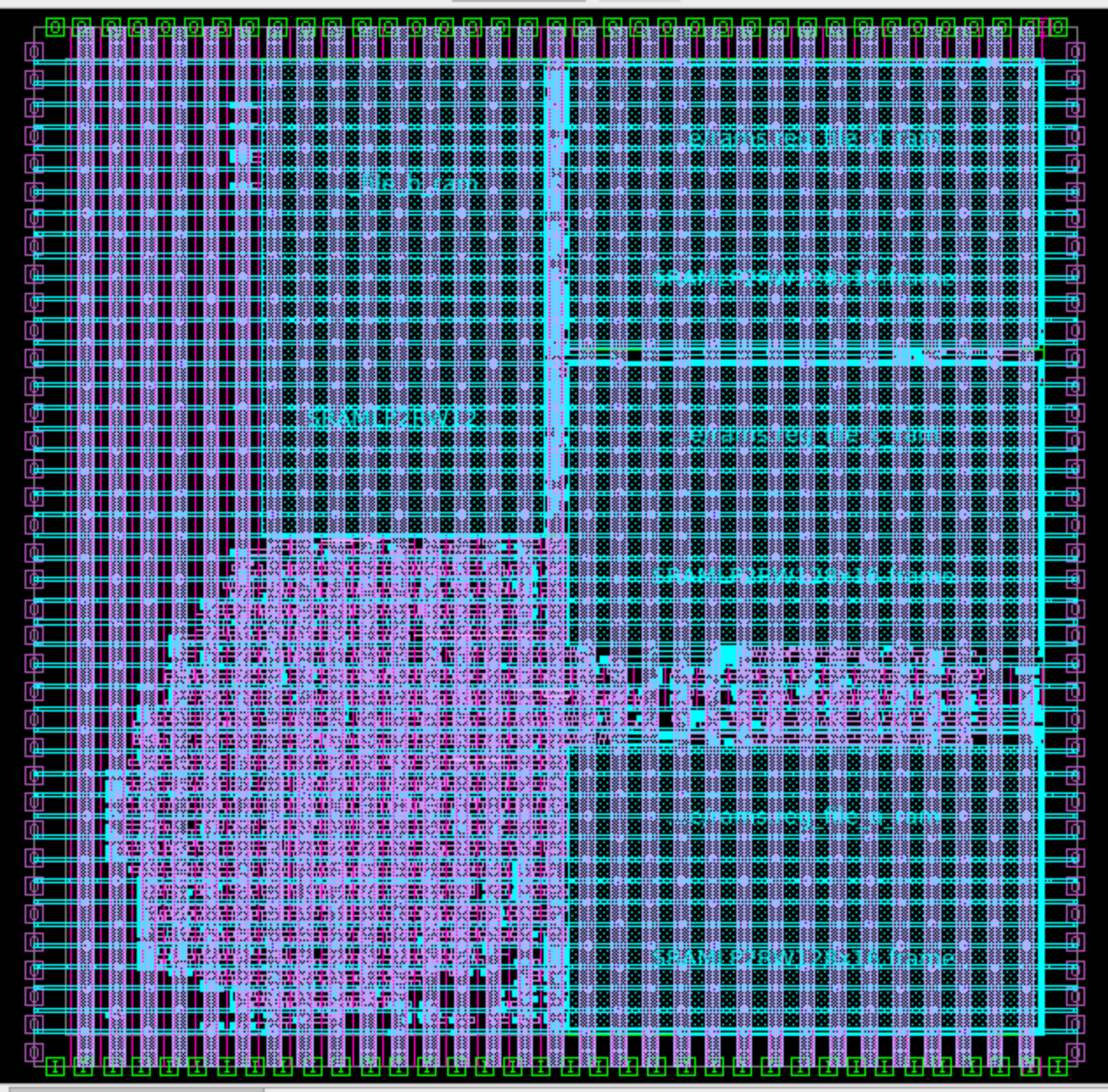
Power-grid networks extracted from Synopsys Fusion Compiler, synthesized and placed-and-routed with the SAED32 (Synopsys 32/28 nm Generic) library.

Per-design statistics, IR-drop, time-to-failure, and Krylov acceleration. TTF > 5.0×10⁷ s indicates the 10% threshold was not reached within the simulated horizon.
DesignTreesMax br.Max nodes Init IR %Final IR %TTF (s) MortalBase (s)Krylov (s)SpeedupErr %
AES_new97693,4506.146.86>5.0×10⁷6884.563.761.21×0
armcore_pad68341,7000.290.29>5.0×10⁷02.351.991.18×0
JPEG_new1781266,3006.566.77>5.0×10⁷1,82116.3112.901.26×0
armcore_logic20821810,9008.8522.211.05×10⁷20640.6031.481.29×0
dual_ram55291,4500.090.10>5.0×10⁷1792.321.551.50×0
risc_core1861155,7506.1929.642.47×10⁷185.404.451.21×0

The largest design (armcore_logic — 208 trees, up to 10,900 nodes) completes in ~31.5 s with Krylov acceleration; the smallest (dual_ram) finishes in under 1.6 s. risc_core's final IR-drop jumps from 6.19% to 29.64% with only 18 mortal trees, underscoring that a few high-current trees can dominate degradation.

Read the paper

Predictive full-chip EM-IR sign-off, unified

Spatial thermal fields, resistance feedback, void-growth physics, and stochastic material variation — handled together, at full-chip scale.